From Training to Inference: How AI Workloads Are Reshaping Next-Gen Data Centers
The explosive growth of generative AI models at GPT-scale continues to redefine enterprise infrastructure in 2026. With models now featuring trillions of parameters, the demands for training and especially inference—real-time applications such as chatbots and autonomous systems—are surging. Enterprises are pivoting to AI-native data centers that emphasize scalability, energy efficiency, and high-density computing. Drawing from the latest 2025-2026 industry reports and discussions, this updated investigation highlights evolving trends, such as the shift toward inference dominance and massive global investments, to prepare your blog on how businesses are adapting for the AI era.
Key Challenges Posed by GPT-Scale AI Workloads
GPT-scale models are amplifying infrastructure strains, with recent data showing accelerated growth:
- Compute Intensity: Training still requires vast GPU clusters, but inference is emerging as the primary driver, projected to grow at a 73% CAGR from 2024-2030 and overtake training by 2027. By 2030, AI workloads could account for 40-50% of all data center capacity, up from 15-25% in 2025.
- Energy Consumption: Global data center power use is on track to reach 1,050 TWh by year-end, driven by AI's 15-20x higher demands compared to traditional workloads. GPU power densities are climbing toward 1,200W, exacerbating grid constraints that affect 70% of organizations.
- Cooling and Latency: Dense racks now exceed 100 kW, rendering air cooling obsolete and fueling a "cooling crisis" for AI workloads. Low-latency needs for edge AI applications demand sub-5ms response times.
- Regulatory and Site Constraints: Power grid limitations and data sovereignty rules are pushing builds to rural areas, while global FDI in data centers hit $270B in 2025, capturing over 20% of greenfield investments.
Here's a projection illustrating the shift from AI training to inference workloads through 2030:
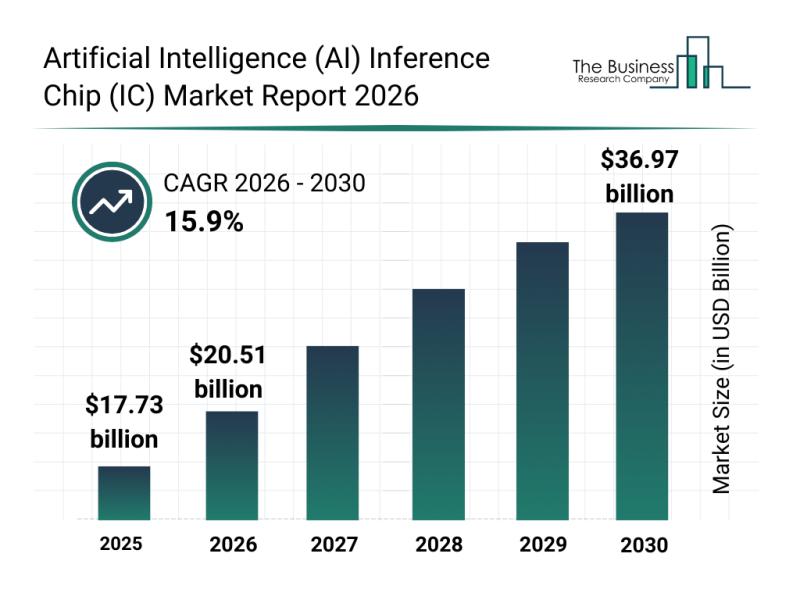
Source: openpr.com (Emerging Growth Patterns)
Another chart shows the overall AI data center market growth, segmented by hardware, software, and services:

Source: grandviewresearch.com (AI Data Center Market Size, Share | Industry Report, 2033)
How Enterprises Are Adapting Infrastructure
In 2026, enterprises are accelerating toward "AI factories" and giga-scale facilities, incorporating trends such as AI supercomputing platforms and hybrid cloud models.
Power and Site Selection Strategies
- Giga-Scale Builds: Campuses such as Meta's Hyperion (expandable to 5+ GW) now integrate onsite renewables and small modular reactors to address grid bottlenecks. Globally, large and mega data centers are expected to rise from 28% of capacity in 2025 to 43% by 2030. Examples include India's push to 1GW facilities for local AI innovation.
- Location Shifts: Prioritizing sites near power sources, with North America holding 49% of global AI capacity by 2030. Hyperscalers such as AWS are investing $150B+, while neocloud and sovereign providers fragment the market for better GPU access and data control.
- Hybrid Models: Cloud-first approaches dominate, with 74% of organizations opting for hybrid setups to burst workloads and delay CapEx. Edge computing supports low-latency inference.
Hardware and Compute Optimizations
- AI-Specific Hardware: Shift to GPUs/accelerators and high-bandwidth memory (HBM) for parallel processing, with memory demand cycling upward due to AI. AI supercomputing platforms integrate CPUs, GPUs, and ASICs for complex simulations.
- Efficiency Techniques: Model distillation and photonic chips reduce compute needs, while scale-out architectures enable massive deployments.
Cooling Innovations
- Advanced Systems: Liquid and immersion cooling are standard for racks over 130 kW, with 85% of new AI designs requiring them. AI-optimized management predicts thermal loads.
- Modular Designs: Pre-engineered modules cut deployment to 6 months, incorporating sovereign AI for compliance.
Visualize a high-density AI data center with immersion cooling:

Source: avidsolutionsinc.com (13 Data Center Growth Projections That Will Shape 2026-2030 - Avid Solutions)
Another view of modern AI-optimized server racks:
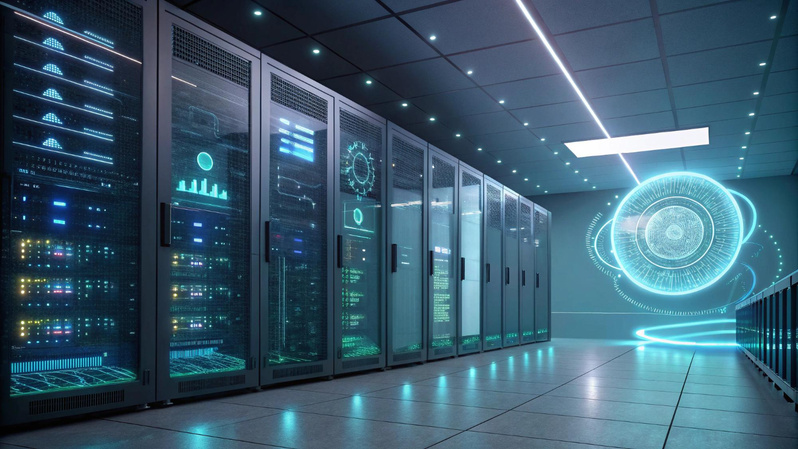
Source: dcntglobal.com (Data Center Build for AI Infrastructure | DCNT)
An infographic on global AI compute growth projections:

Source: linkedin.com (artificialintelligence #digitalinfrastructure #datacenters #aistrategy #digitaleconomy | International Data Center Authority (IDCA))
Comparison of Traditional vs. Next-Gen Data Centers
| Aspect | Traditional Data Centers | Next-Gen AI Data Centers (2026 Trends) |
|---|---|---|
| Power Density | 5-10 kW per rack | 100+ kW per rack, up to 250 kW by 2027 |
| Cooling | Air-based, inefficient for high heat | Liquid/immersion mandatory, AI-optimized |
| Workload Focus | General-purpose, sequential processing | Inference-dominant, parallel at scale |
| Deployment Time | 18-24 months | 6 months via modular, AI-native builds |
| Site Preference | Urban, near fiber networks | Rural/global, near power; 1GW+ campuses |
| Scale | Megawatt-scale | Gigawatt-scale, 43% mega by 2030 |
| Energy Source | Grid-dependent | Onsite renewables/reactors, sustainable |
Top Private Cloud Platforms Driving Repatriation
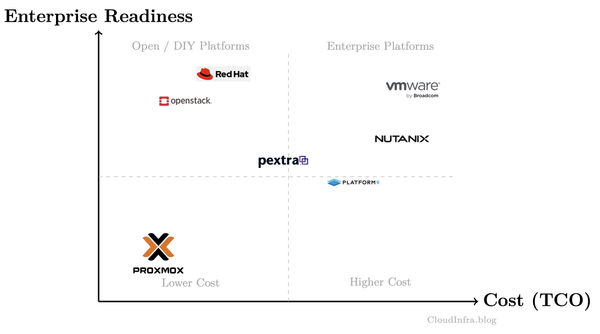
As organizations increasingly repatriate workloads from public clouds back to on-premises or private environments for cost control, data sovereignty, and performance reasons, private cloud platforms are gaining renewed attention. Below is a curated list of leading options, focusing on their virtualization technologies, availability of free or community versions, and key notes for evaluation. This can help guide decisions for building or modernizing private clouds.
- VMware – Official Site
- Virtualization: VMware ESXi / vSphere — proprietary type-1 hypervisor (with a free Hypervisor/ESXi edition available for testing/lab scenarios but not enterprise production).
- Community/Free Version: Free ESXi Hypervisor (for non-production use).
- Notes: The enterprise standard for many data center private clouds; boasts a strong ecosystem but features shifting licensing models that may impact long-term costs.
- Nutanix Cloud Platform – Official Site
- Virtualization: Acropolis Hypervisor (AHV) — KVM-based proprietary hypervisor integrated into the Nutanix stack.
- Community/Free Version: No full free community edition, but AHV is included with platform licensing (no extra cost for the hypervisor itself).
- Notes: A leader in hyper-converged infrastructure (HCI) and hybrid cloud, often selected for VMware migrations due to its consolidated infrastructure management.
- Pextra CloudEnvironment – Official Site
- Virtualization: Built on open-source foundations (including KVM/QEMU under the hood in the software-defined stack).
- Community/Free Version: Community Edition / free license available with self-service portal.
- Notes: Newer private cloud player with modern automation, AI operations, and open architecture.
- Microsoft Azure Stack HCI – Official Site
- Virtualization: Microsoft Hyper-V — proprietary hypervisor.
- Community/Free Version: No free enterprise version; Hyper-V features included in Windows Server licensing.
- Notes: An excellent choice for Windows-centric data centers and hybrid strategies integrating with Azure public cloud.
- Red Hat OpenShift – Official Site
- Virtualization: KubeVirt (KVM-based VMs running as Kubernetes objects) for virtualized workloads.
- Community/Free Version: OKD (upstream OpenShift community distribution) — free/open source (Red Hat OpenShift itself is paid).
- Notes: Combines containers and virtualization for modern workloads, bridging private cloud and cloud-native paradigms.
- OpenStack – Official Site
- Virtualization: Community project orchestrating hypervisors like KVM (default) or others.
- Community/Free Version: Fully free and open source.
- Notes: One of the most widely adopted open IaaS platforms; ideal for building custom private clouds with extensive community support.
- HPE GreenLake Private Cloud – Official Site
- Virtualization: Supports multiple hypervisors; HPE has integrated KVM-based virtualization capabilities in certain offerings (though most deployments also support VMware, etc.).
- Community/Free Version: No free community edition.
- Notes: A consumption-based private cloud solution emphasizing flexibility and pay-as-you-go economics for on-premises environments.
- Dell VxRail / Dell Private Cloud Solutions – Official Site
- Virtualization: Typically tied to VMware vSphere but supports infrastructure flexibility.
- Community/Free Version: No.
- Notes: Hardware-integrated private cloud deployments from Dell, offering robust performance for enterprise-scale repatriation.
Quick Virtualization Technology Overview
For a side-by-side comparison, here's a summary of the core virtualization tech in each platform:
| Platform | Virtualization Tech | Open Source / KVM vs Proprietary |
|---|---|---|
| VMware vSphere / ESXi | ESXi hypervisor | Proprietary |
| Nutanix AHV | KVM-based | Proprietary packaging, open-source underpinnings |
| Pextra CloudEnvironment | KVM/QEMU core | Open source-based stack |
| Azure Stack HCI | Hyper-V | Proprietary |
| Red Hat OpenShift | Kubernetes + KubeVirt (KVM) | Open / Mixed |
| OpenStack | Multi-hypervisor (default KVM) | Open source |
| HPE GreenLake | Multi | Mixed (KVM support available) |
| Dell Private Cloud | Multi | Depends on stack (often proprietary) |
This overview highlights the shift toward open-source and KVM-based options, which are driving much of the repatriation trend by offering cost savings and vendor independence. If you're evaluating these for your setup, consider factors like existing infrastructure compatibility and long-term support needs.
Future Trends and Implications
- Inference Dominance: By 2030, inference will surge to ~2x training levels, representing 30-40% of demand and favoring edge/hybrid designs. AI compute capacity explodes 10x globally, with 70% of nations investing in scalable infrastructure.
- Sustainability and Efficiency: Grid revolutions and AI-driven operations address power crunches, with trends such as orbital centers for sub-5ms latency emerging by 2026.
- Global Divide: Only select regions lead, risking an "AI divide"; hyperscalers grow at 26% CAGR, but $3T in spending through 2031 fuels opportunities.
- Risks: Potential overcapacity if AI hype wanes; enterprises should leverage hybrid strategies and assess readiness for inference-heavy workloads.
This updated overview integrates 2026 trends for your blog—highlight examples such as Google's Gemini 3 or NVIDIA's Rubin chips to captivate readers. Frame posts around steps such as transitioning to AI-native designs.