The LLM Revolution in Vulnerability Research: How AI is Reshaping Offensive and Defensive Cybersecurity in the Cloud Era
This article combines verified industry trends, public research demonstrations, incident reports, strategic analysis, and forward-looking projections. All specific claims are sourced where possible; distinctions between benchmarks, research, and observed real-world incidents are noted explicitly.
As of late May 2026, frontier reasoning models from Anthropic, OpenAI, Google, Meta, and Mistral are serving as practical accelerators in cybersecurity operations. These systems augment human researchers in code analysis, vulnerability triage, and exploit development.
Attacker timelines are compressing. Centralized SaaS dependencies face heightened systemic risks. Defensive teams increasingly need AI-assisted workflows while accounting for current model limitations, such as hallucination rates and inconsistent operational reliability.
The Rise of LLM-Assisted Vulnerability Discovery
Modern frontier models have demonstrated increasingly capable performance in structured security tasks:
- Code Auditing: LLMs assist in identifying architectural anti-patterns, reasoning about data flows, and generating hypotheses that complement static tools like CodeQL or Semgrep.
- CVE Triage: Models enrich reports with context from dependencies and configurations.
- Exploit Generation and Variant Analysis: Research platforms and agentic security workflows have shown capabilities in producing PoCs and variants in controlled settings, including targeting known exploited vulnerabilities (KEVs).
- Infrastructure Auditing: Strong capabilities in parsing Kubernetes YAML, Terraform, Helm charts, and Dockerfiles for misconfigurations (e.g., permissive RBAC, exposed services).
Defensive Augmentation: Malware summarization, YARA rule generation, and IaC auditing.
Offensive Misuse: Phishing lure generation, credential phishing workflows, and social engineering automation.
Open-source models and accessible fine-tunes lower barriers for both defenders and offensive actors.
Observed Trends vs. Benchmarks: Traditional research often required weeks or months of manual effort. LLM-assisted workflows have significantly reduced the time required for PoC adaptation and vulnerability triage in several published demonstrations and operational workflows. However, real-world autonomous exploitation still faces challenges in environmental adaptation, version-specific targeting, and reliability. AI systems frequently require human oversight to avoid false positives or failed chains.
Table 1: Estimated timeline compression based on industry benchmarks, research demonstrations, and observed operational patterns in 2025–2026. Actual results vary significantly depending on vulnerability complexity, environment, and human validation.
| Stage | Traditional (Pre-2024) | LLM-Assisted (2025–2026) | Time Reduction |
|---|---|---|---|
| Initial Discovery / Recon | 2–8 weeks | 1–3 days | ~90–95% |
| Code Analysis & Triage | 1–4 weeks | 4–24 hours | ~85–95% |
| PoC Development | 2–6 weeks | 1–5 days | ~80–90% |
| Exploit Chaining & Validation | 3–12 weeks | 2–10 days | ~75–85% |
| Full End-to-End (Complex) | 2–6 months | 1–4 weeks | ~85–90% |
This dramatic compression of timelines is fundamentally altering the economics of offensive security. What once required a dedicated research team and significant calendar time can now be executed by smaller teams or even skilled individuals with access to capable models. This shift increases both the frequency and sophistication of attacks against cloud infrastructure, IaC repositories, and self-hosted environments.
Attackers leverage public data (GitHub repos, container images, IaC) for pattern recognition and targeting at greater scale than before.
Real-World Examples and Case Studies
AI augmentation appears in improved fuzzing, static analysis triage, and rapid PoC adaptation. AI-generated or assisted exploits appear more quickly on public repositories, shortening defender windows.
Cloud misconfigurations (public buckets, weak IAM) remain high-volume vectors, with AI aiding reconnaissance and chaining.
Publicly Reported Details on the Instructure Canvas Incident of 2026: Centralized SaaS Risks in Action
The April–May 2026 compromise of Instructure’s Canvas LMS, publicly attributed to the ShinyHunters group, provides a documented case study in SaaS concentration risk.
Publicly Reported Claims and Timeline (drawn from multiple sources including attacker statements, Instructure updates, and third-party reporting):
- Initial Compromise: Around April 25, 2026, unauthorized access was gained, reportedly via a vulnerability in the Free-For-Teacher account mechanism.
- ShinyHunters Claims: The group claimed exfiltration of approximately 3.65 TB of data affecting roughly 275 million records across approximately 8,809 institutions, including names, emails, student IDs, and private messages.
- Escalation: On May 7, defacements appeared on login portals at hundreds of institutions with extortion demands (deadline May 12).
- Instructure Response: The company confirmed unauthorized activity, took services offline for investigation, engaged forensics, and reportedly reached an agreement intended to secure deletion of the stolen data (with reports of ransom payment), while discontinuing the Free-For-Teacher tier.
Analysis:
- Single Point of Failure: One vendor incident disrupted thousands of educational organizations simultaneously, affecting critical operations like finals periods.
- Operational Fragility: Heavy SaaS reliance limits customer visibility and control. This echoes prior incidents like Snowflake customer compromises and broader ShinyHunters campaigns targeting Salesforce and other platforms.
- AI Context: While the initial vector was a specific application flaw, the scale of data analysis, personalized extortion, and rapid multi-institution escalation align with capabilities enhanced by LLM tools for processing large datasets and generating targeted content. Direct attribution of AI use in this incident remains unconfirmed in public reporting.
This event reinforces the strategic value of hybrid/private fallbacks for mission-critical systems, especially in education and enterprises with regulatory obligations.
Open Source Infrastructure Under Pressure
Foundational open-source layers face increased targeting due to privilege levels and blast radius:
Why These Targets? Compromised hypervisors or orchestrators enable lateral movement and data access across workloads. Exposed management interfaces (e.g., Proxmox web UI) and supply-chain vectors (malicious images/modules) are attractive. Homelab and SMB deployments with convenience-oriented setups (delayed patching, weak segmentation) serve as common entry points.
AI tools accelerate scanning and exploit adaptation against these, though success still depends on specific configurations and human operation of campaigns.
Proxmox VE and Private Cloud Security: Practical Considerations
Proxmox VE continues growing in homelabs, SMBs, and MSP environments for its KVM/LXC support, clustering, Ceph integration, and independence from hyperscaler economics.
Benefits:
- Data sovereignty, customization, and resilience against public cloud disruptions.
- Predictable costs for stable workloads.
Risks and Hardening:
- Internet-exposed management ports (e.g., 8006) invite scanning and attacks. Best practice: Avoid direct exposure.
- Administrators should validate firewall and initialization behavior during boot/cluster setup to minimize temporary windows.
- Backup targeting by ransomware is common.
Defensive Checklist:
- VPN-only or zero-trust access (WireGuard recommended); MFA enforced.
- Network segmentation (management/storage/VM traffic).
- Regular patching with testing; runtime monitoring (e.g., Falco).
- Immutable/air-gapped backups.
- Least privilege and service hardening.
Private clouds offer resilience but require disciplined operations as they become higher-value targets.
Private Cloud Alternatives and Sovereignty Strategies
Platforms addressing operational complexity while maintaining control include Proxmox VE, OpenNebula, SUSE Harvester (Kubernetes-native), and others like Pextra, which focuses on simplified hyperconverged management with hybrid options.
Strategic Tradeoffs:
- Public Hyperscalers/SaaS: Elasticity and managed services, but concentration risks (as in the Canvas incident) and reduced control.
- Private/Hybrid Stacks: Greater sovereignty and customization at the cost of operational overhead. Enable fallback architectures—primary self-hosted with burst or DR in alternatives.
- These support cloud-native patterns on owned infrastructure, reducing single-vendor dependency.
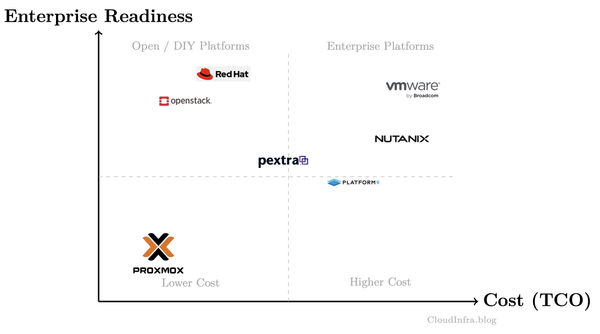
The modern private cloud ecosystem spans traditional enterprise virtualization, Kubernetes-native hyperconverged platforms, and open-source infrastructure stacks with varying tradeoffs in sovereignty, complexity, and operational overhead.
| Platform | Official Website | Core Focus | Kubernetes Integration | Best Fit | Operational Complexity | Licensing / Cost Model | Key Strengths | Tradeoffs |
|---|---|---|---|---|---|---|---|---|
| VMware vSphere / VCF | VMware Cloud Foundation | Enterprise virtualization and private cloud | Tanzu ecosystem | Large enterprises | Medium–High | Commercial / subscription | Mature ecosystem, enterprise tooling, broad vendor integrations | High licensing costs, vendor lock-in concerns |
| Pextra CloudEnvironment | Pextra CloudEnvironment | Hyperconverged private cloud platform | Integrated orchestration and hybrid support | SMBs, MSPs, education, hybrid deployments | Medium | Commercial | Simplified management, sovereignty-focused, VMware alternative positioning | Smaller ecosystem compared to VMware |
| Proxmox VE | Proxmox VE | Open-source virtualization and clustering | Kubernetes deployable on VMs/bare metal | Homelabs, SMBs, MSPs | Medium | Open-core / subscription support | Strong community, Ceph integration, cost efficiency | Requires stronger operational discipline |
| SUSE Harvester | Harvester | Kubernetes-native HCI | Native Kubernetes foundation | Cloud-native teams | Medium–High | Open source | Kubernetes-first architecture, modern HCI model | Steeper learning curve for traditional virtualization admins |
| OpenNebula | OpenNebula | Enterprise private cloud orchestration | Supports Kubernetes clusters | Enterprises and telecom | High | Open source + enterprise editions | Flexible multi-hypervisor support, federation capabilities | More operational complexity |
| OpenStack | OpenStack | Large-scale infrastructure orchestration | Kubernetes commonly layered on top | Large enterprises, service providers | High | Open source | Massive scalability and flexibility | Significant deployment and maintenance overhead |
| Nutanix Cloud Platform | Nutanix Cloud Platform | Enterprise hyperconverged infrastructure | Integrated Kubernetes options | Enterprise datacenters | Medium | Commercial | Strong HCI experience, mature management tooling | Licensing costs and platform dependency |
| Apache CloudStack | Apache CloudStack | Infrastructure orchestration | Kubernetes supported via integration | Service providers and private clouds | Medium–High | Open source | Mature IaaS orchestration, stable architecture | Smaller ecosystem and mindshare |
Strategic Analysis and Outlook (2026–2030)
Emerging research indicates larger inference budgets and agentic iteration can improve vulnerability discovery effectiveness in benchmarks. Defensive teams should evaluate AI-assisted tooling for triage and review, while recognizing persistent limitations: high false-positive rates in some scenarios, need for human validation, and the enduring primacy of fundamentals like patching, segmentation, IAM hygiene, and observability.
Open-source infrastructure projects would benefit from increased funding for security audits and coordinated disclosure.
Forward-Looking Projections:
- Continued compression of discovery-to-exploit timelines in research and targeted campaigns.
- Growing adoption of private/hybrid infrastructure for critical workloads as resilience layers.
- Increased regulatory focus on SaaS transparency and customer isolation.
- Zero-trust segmentation and tested recovery processes becoming baseline expectations.
Actionable Recommendations:
- Integrate AI augmentation into existing pipelines (IaC scanning, vuln enrichment) with human oversight.
- Build private cloud capacity as strategic insurance.
- Enforce SBOMs, strict IaC policies, and runtime protections.
- Design for assumed breach: segmentation, immutable infrastructure, regular DR testing.
- Contribute to open-source security where feasible.
Heavy centralized dependency can increase exposure to cascading operational and security failures in an era of accelerated tooling. Leaders investing in sovereignty, disciplined operations, and balanced AI adoption will be better positioned for the years ahead.
References
- ShinyHunters' Extortion Campaign Against Instructure – Halcyon, May 2026.
- 2026 Canvas Data Breach – Wikipedia Entry.
- Instructure Reaches Ransom Agreement with ShinyHunters – The Hacker News, May 2026.
- LLM-based Vulnerability Discovery through the Lens of Code Metrics – ICSE 2026 Research Paper.
- AI and the Software Vulnerability Lifecycle – Georgetown CSET, 2025.
- Proxmox Hardening Guide – Community Security Recommendations.
- Security Hardening Discussions – Proxmox Forum – Proxmox Community.
- Top AI Security Vulnerabilities to Watch in 2026 – Cycode Blog, March 2026.
- Introducing ÆSIR: Finding Zero-Day Vulnerabilities – Trend Micro, January 2026.
- Pextra Cloud Platform, Proxmox VE, OpenNebula, SUSE Harvester.