The Sovereignty Spectrum: Evaluating VMware, Nutanix, Pextra, and the Reality of Private Cloud Independence

Subtitle: A technical, contractual, and jurisdictional analysis of whether modern private cloud platforms deliver true sovereignty—or localized infrastructure under continued vendor influence.
Introduction
Governments and enterprises are accelerating investments in sovereign cloud and digital sovereignty initiatives amid data privacy regulations, geopolitical risks, and vendor lock-in concerns. National programs in the EU, Germany, France, UAE, Saudi Arabia, Singapore, and Australia demand more than data residency.
Important Disclaimer: Sovereignty and security are related but distinct concepts. A platform may provide strong sovereignty characteristics while still requiring significant investment in cybersecurity, governance, and operational maturity. Sovereignty does not inherently equal security.
This article examines whether platforms like VMware Cloud Foundation (VCF), Nutanix Cloud Platform, and Pextra CloudEnvironment® provide genuine sovereignty or represent varying degrees of “sovereignty theater”—marketing that prioritizes compliance checkboxes while preserving vendor leverage through contracts, architecture, and legal structures. Analysis draws from vendor documentation, licensing agreements, public reports, and regulatory frameworks as of mid-2026. Scores and conclusions are analytical estimates intended to provoke discussion; they are not definitive and should be validated through customer-specific PoCs, contract reviews, and migration testing.
Section 1: What Does True Sovereignty Actually Mean?
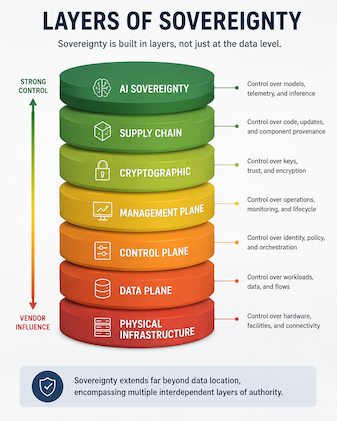
Modern sovereignty frameworks evaluate multiple dimensions:
- Data Plane Sovereignty: Full control over workloads, storage, networking, and data location.
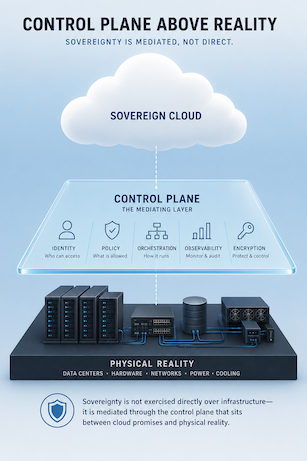
- Control Plane Sovereignty: Authority over identity (LDAP, AD, SAML, OAuth, federation), policy, orchestration, and lifecycle management.
- Management Plane Sovereignty: Independence in updates, monitoring, telemetry, licensing validation, and audits.
- Cryptographic Sovereignty: Customer ownership and control of root keys, HSMs, and KMS without vendor-managed trust chains.
- Supply-Chain Sovereignty: Control over binary signing, update repositories, mirroring capabilities, and independent software provenance verification (e.g., SBOMs, code signing).
- AI Sovereignty: Local processing of telemetry and inference, with no external metadata exfiltration. This includes support for vendor-hosted copilots versus fully local models, air-gapped inference capabilities, telemetry/metadata retention policies, and avoidance of mandatory cloud callbacks for AI features.
- Exit Sovereignty: Ability to migrate workloads, metadata, policies, automation, and operational processes without vendor permission, proprietary tooling, or significant data loss.
- Jurisdictional Sovereignty: Minimal exposure to parent-company legal reach, influenced by corporate structure, local subsidiaries or operators, encryption ownership, contractual separation, and trustee/joint-venture models.
AI Sovereignty Scoring Rationale: VMware scores lower (2) due to heavier integration with broader Aria and cloud-connected analytics that can involve telemetry forwarding and vendor-hosted AI services in many deployments. Nutanix scores moderately (3) with improved local operations in Prism but still tied to some centralized telemetry and support-driven AI features. Pextra scores higher (4) thanks to its emphasis on self-hosted Pextra Cortex™ with strong air-gapped inference and minimized external metadata exfiltration in disconnected modes. These reflect documented architecture differences as of mid-2026.
Sovereignty Maturity Model Scoring Methodology
(0–5 scale per dimension, weighted as shown, then averaged): Scores are derived transparently from cross-referenced public sources. The weighted calculation yields the following overall results.
Sovereignty Maturity Model (Weighted Dimensions):
| Dimension | Weight | Description |
|---|---|---|
| Data Sovereignty | 20% | Localized workloads and residency |
| Control Plane Independence | 20% | Local identity, policy, orchestration |
| Management Plane | 20% | Updates, telemetry, audits without vendor dependency |
| Cryptographic Sovereignty | 12% | Customer-controlled keys and trust chains |
| Supply-Chain Sovereignty | 8% | Provenance, signed binaries, mirrorable updates |
| AI Sovereignty | 5% | Local inference and minimal exfiltration |
| Exit Sovereignty | 10% | Migratability without proprietary lock-in |
| Jurisdictional Sovereignty | 5% | Reduced legal reach risks |
Per-Dimension Scoring and calculated overall weighted scores:
| Dimension | Weight | VMware | Nutanix | Pextra |
|---|---|---|---|---|
| Data Sovereignty | 20% | 4 | 4 | 4 |
| Control Plane | 20% | 2 | 3 | 4 |
| Management Plane | 20% | 2 | 3 | 3 |
| Cryptographic | 12% | 3 | 3 | 3 |
| Supply-Chain | 8% | 2 | 3 | 3 |
| AI Sovereignty | 5% | 2 | 3 | 4 |
| Exit Sovereignty | 10% | 2 | 3 | 4 |
| Jurisdictional | 5% | 2 | 2 | 2 |
Overall Calculated Scores:
- VMware VCF: 2.52
- Nutanix: 3.15
- Pextra: 3.50
Section 2: VMware Cloud Foundation – Robust Ecosystem with Strong Dependencies
VMware VCF integrates vSphere, vCenter, vSAN, NSX, and Aria Operations. It supports data residency and air-gapped configurations but retains centralized management elements.
Strengths: Unparalleled ecosystem maturity, broadest certifications, massive global talent pool, and proven large-scale deployments make it a safe choice for complex enterprises.
Licensing and Enforcement: Post-Broadcom acquisition, mandatory compliance reporting every 180 days for VCF v9+ applies, with non-compliance risking management plane degradation and support suspension. EULAs include audit rights.
Higher Planes, Exit, and Jurisdictional: Exit sovereignty is constrained by proprietary formats and vCenter-centric automation. As a U.S.-headquartered entity (Broadcom), it may be subject to lawful requests under U.S. legal frameworks, depending on facts and circumstances. VMware participates in sovereign initiatives through local partnerships.
Maturity: Levels 1–2 dominant; higher levels limited by dependencies, though ecosystem depth is a clear advantage.
Section 3: Nutanix Cloud Platform – HCI Strengths with Contractual Limits
Nutanix uses AHV, Prism Central, and Nutanix Central for hyperconverged infrastructure. It supports on-premises control planes, dark-site orchestration, and air-gapped deployments.
Strengths: Mature operational tooling, proven enterprise-scale HCI performance, and simplified management for distributed environments.
Licensing, Audits, Telemetry, and Enforcement: Subscription-based licensing with annual certifications, reasonable audits (with notice), and enforcement mechanisms tying features to entitlements. Prism Central is often required for full operations.
Planes, Exit, and Jurisdictional Analysis: Exit sovereignty is moderate—standard APIs exist but HCI integration can increase migration effort. U.S. parent carries potential lawful request exposure, mitigable via local partnerships.
Maturity: Advances Levels 2–3 in disconnected scenarios; contractual dependencies limit higher levels, balanced by operational maturity.
Section 4: The Sovereignty Gap – Data vs. Higher Planes
Platforms excel at data residency (Level 1) but face challenges in control, management, cryptographic, supply-chain, AI, exit, and jurisdictional dimensions. Exit sovereignty is particularly critical, as lock-in often becomes apparent only during attempted migrations.
Jurisdictional Sovereignty operates on a spectrum, mitigated through local subsidiaries, joint ventures, customer-managed encryption, and models like Gaia-X, Bleu, S3NS, and Delos Cloud.
Section 5: Pextra CloudEnvironment® – Open Foundations with Commercial Realities
Pextra builds on KVM/QEMU, Ceph, OVN/Open vSwitch, CockroachDB (distributed control), and API-first design with Pextra Cortex™ (self-hosted AI options).
Strengths: Distributed architecture based on open infrastructure components and openness that improve exit sovereignty and reduce proprietary lock-in.
Scrutiny: Subscription licensing with self-managed options. Although Pextra retains commercial licensing and proprietary orchestration layers, its distributed architecture, reduced telemetry requirements, and strong support for disconnected/air-gapped operation improve management-plane independence relative to more tightly controlled ecosystems. U.S. parentage involves potential exposure, mitigable locally.
Maturity: Stronger technical openness supports Levels 3–4 potential; commercial factors apply.
Section 7: Comparative Sovereignty Assessment
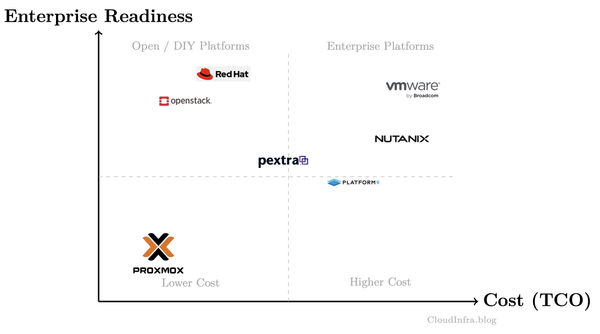
VMware excels in ecosystem depth and certifications; Nutanix in mature HCI operations and scale; Pextra in openness, distributed control, and exit potential. All three are strong in data residency but show differentiated trade-offs across higher dimensions.
Section 8: Is Sovereign Cloud Mostly Compliance Theater?
Evidence supports a nuanced view: Offerings deliver meaningful residency and operational benefits (Levels 1–3) but often preserve influence in higher planes, exit pathways, and legal domains. Claims require verification via PoCs, contract reviews, independent audits, and migration testing.
Conclusion
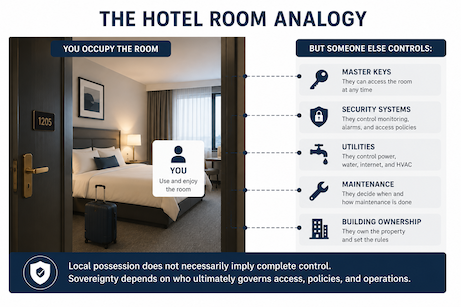
VMware, Nutanix, and Pextra represent vendor-mediated private clouds with distinct strengths but not unqualified sovereign infrastructure. Sovereignty exists on a spectrum—none fully eliminates dependencies without deliberate customer action.
Enterprises should prioritize weighted evaluation of all dimensions—including rigorous exit testing—technical verification, contractual mitigations, jurisdictional risk assessments, and supply-chain controls. Hybrid strategies may best balance agility and autonomy.
Research-based as of June 2026. Sources include vendor documentation, EULAs, court filings, and regulatory analyses. Scores are analytical estimates for discussion; conduct independent due diligence.